What Is Microsoft Copilot Studio? A Comprehensive Guide 2026
Autonomous AI agents are no longer a futuristic concept — they are running in production environments at thousands of organizations right now. If your team is still manually routing support tickets, copy-pasting data between systems, or waiting on developers to build every automation, you are already behind. Microsoft Copilot Studio has evolved from a capable chatbot builder into a full-scale agent orchestration platform, and the gap between early adopters and everyone else is widening fast. This guide explains exactly what Copilot Studio is, what is new in 2026, how it compares to the competition, and how to decide whether it belongs in your technology stack.
Table of Contents
Table of Contents
Table of Contents
Microsoft Copilot Studio Overview
Microsoft Copilot Studio is a low-code platform that lets organizations build, deploy, and manage AI-powered agents — from simple FAQ bots to sophisticated autonomous agents that can plan, reason, and execute multi-step tasks across enterprise systems. It sits within the Microsoft Power Platform family and connects natively to Microsoft 365, Azure, Dynamics 365, and hundreds of third-party applications.
When the platform launched in 2023, it was primarily known as the successor to Power Virtual Agents — a tool for building rule-based conversational chatbots. By 2026, that description undersells it significantly. Copilot Studio now serves as the primary authoring environment for custom AI agents that can be embedded in Microsoft Teams, published to websites, integrated into Dynamics 365 workflows, or orchestrated alongside other agents in multi-agent pipelines.
According to Microsoft’s Ignite 2024 keynote, more than 50,000 organizations were already using Copilot Studio to build custom copilots as of early 2026 — and that number has grown considerably since. The broader Microsoft Power Platform, which includes Copilot Studio, surpassed 33 million monthly active users as of Microsoft’s fiscal year 2024 earnings call.
The market context matters here. Gartner forecast that by 2026, more than 80% of enterprises will have deployed AI-powered conversational agents — up from fewer than 5% in 2021. Copilot Studio is one of the primary vehicles through which Microsoft’s enterprise customers are meeting that threshold.
What changed for 2026: The platform’s identity has shifted from “chatbot builder” to “agent development platform.” Autonomous agent orchestration, multi-agent workflows, and GPT-4o integration are now core capabilities rather than preview features.
Key Features and Benefits of Microsoft Copilot Studio
Copilot Studio packs a substantial feature set that serves both non-technical business users and experienced developers. Here are the capabilities that matter most in 2026.
No-Code and Low-Code Agent Building
The visual canvas remains one of Copilot Studio’s most important differentiators. Business users with no programming background can:
- Design conversation flows using a drag-and-drop topic editor
- Configure generative AI responses grounded in SharePoint, OneDrive, or uploaded documents
- Set up triggers based on events in Microsoft 365, Dynamics 365, or external systems
- Test agents in a built-in emulator before publishing
For developers who want to go deeper, the platform supports custom code in Power Fx and TypeScript, giving technical teams full control over complex logic without abandoning the visual environment.
Expanded Connector Library (1,000+ Connectors)
One of the biggest practical upgrades entering 2026 is the connector ecosystem. Copilot Studio now provides access to more than 1,000 connectors through Power Platform, enabling agents to read from and write to systems including:
- Microsoft ecosystem: SharePoint, Teams, Outlook, Dynamics 365, Azure SQL, OneDrive
- CRM and ERP: Salesforce, SAP, Oracle, HubSpot
- Productivity and ITSM: ServiceNow, Jira, Zendesk, Slack
- Data and analytics: Dataverse, Power BI, Azure Data Lake
This breadth means agents can retrieve real-time information, trigger workflows, update records, and surface insights — all within a single conversation or automated pipeline.
Autonomous Agent Orchestration and Multi-Agent Workflows
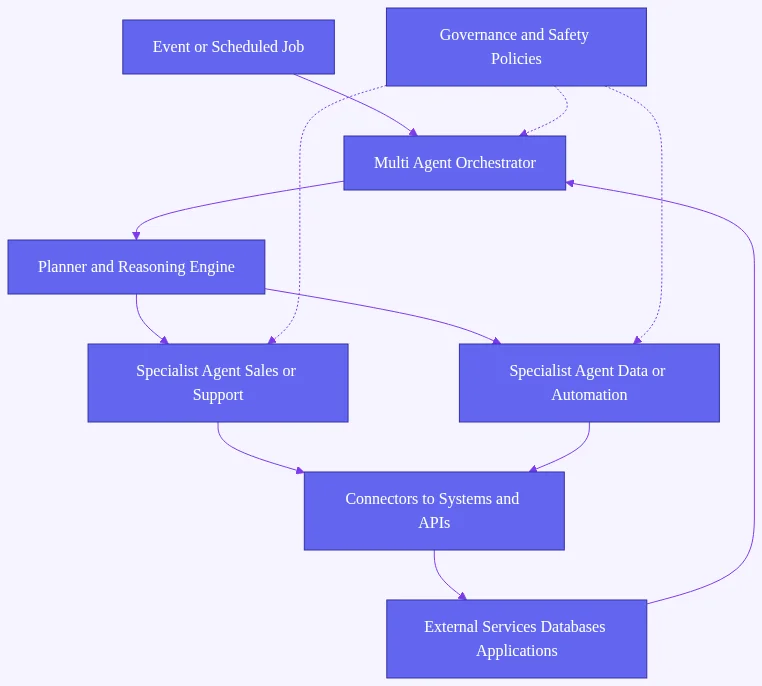
This is the headline capability for 2026. Copilot Studio now supports autonomous agents — agents that do not simply respond to prompts but can plan a sequence of actions, call external tools, evaluate results, and iterate until a goal is achieved.
More significantly, Copilot Studio enables multi-agent orchestration, where a primary orchestrator agent delegates subtasks to specialized agents. For example, a customer service orchestrator might hand off a billing inquiry to a finance agent, a technical issue to an IT support agent, and a product question to a knowledge-base agent — all transparently, within a single user interaction.
This architecture mirrors how enterprise teams actually work and dramatically expands what is achievable without custom development.
GPT-4o Integration and Generative Answers
Copilot Studio’s generative AI capabilities are powered by large language models, including GPT-4o, accessed through Azure OpenAI Service. This enables:
- Generative answers: Agents can answer questions not covered by authored topics by grounding responses in connected knowledge sources
- Natural language understanding: Agents interpret intent even when users phrase questions in unexpected ways
- Summarization and reasoning: Agents can synthesize information from multiple data sources before responding
Importantly, all generative AI calls are routed through Azure OpenAI, meaning your data does not leave Microsoft’s compliance boundary and is not used to train public models.
Native Microsoft 365 and Teams Integration
For organizations already running Microsoft 365, Copilot Studio agents can be published directly to Microsoft Teams with minimal configuration. Agents appear as apps within Teams, accessible in personal chats, group channels, or as tab experiences. This removes the deployment friction that often slows AI adoption in enterprise environments.
Agents can also be embedded in the Microsoft 365 Copilot experience itself — meaning the custom knowledge and workflows you build in Copilot Studio can surface directly within Word, Excel, Outlook, and other M365 apps your employees use every day.
What changed for 2026: Multi-agent orchestration and autonomous planning capabilities have moved from limited preview to general availability, making them production-ready for enterprise deployments.
Copilot Studio Architecture
Understanding how Copilot Studio is built helps IT teams assess integration complexity, security posture, and scalability. The platform rests on four architectural layers.
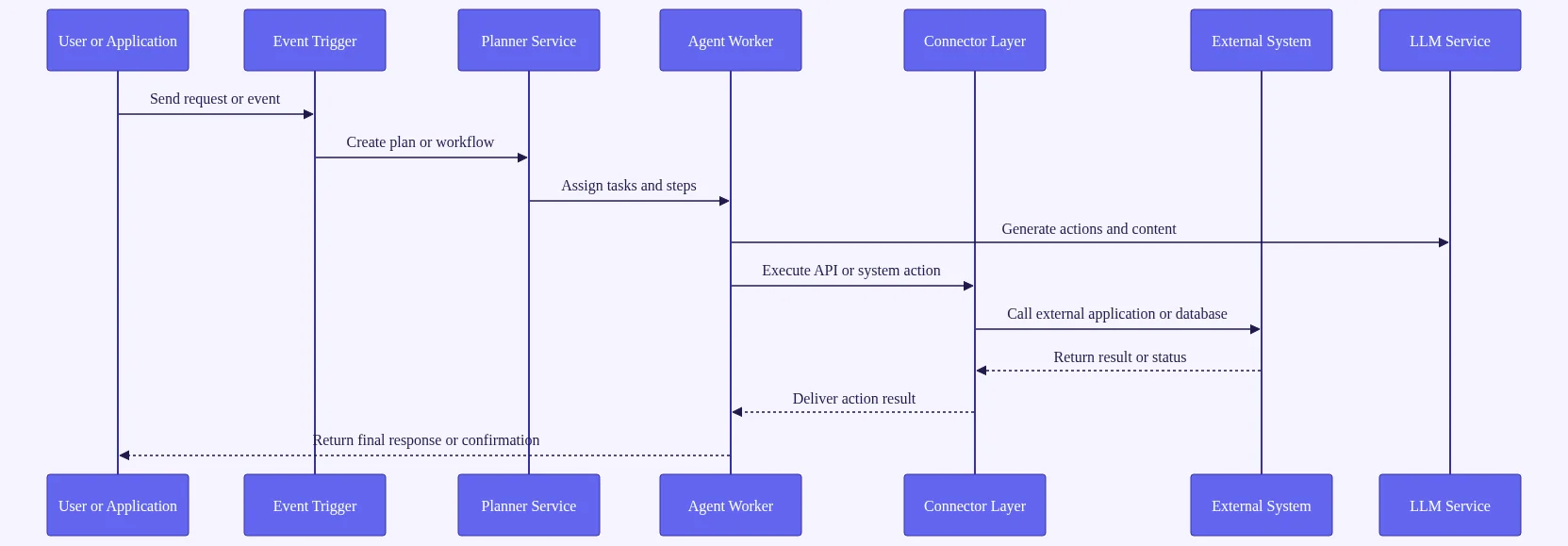
User Interface Layer
The web-based authoring canvas at copilotstudio.microsoft.com is where agents are designed, tested, and published. It is accessible from any modern browser without local software installation. Role-based access controls determine who can create, edit, publish, or view agents within a given environment.
Backend Services and Dataverse
Agent configurations, conversation history, and custom data are stored in Microsoft Dataverse — the same data platform that underpins Dynamics 365. This gives Copilot Studio agents access to structured business data with row-level security, auditing, and compliance controls already built in.
AI and Language Model Layer
Natural language processing, intent recognition, generative answers, and autonomous reasoning are handled by Azure AI services, including Azure OpenAI. Administrators can configure which AI models are available within their tenant and apply content filtering policies through Azure AI Content Safety.
Security and Compliance Layer
Data loss prevention (DLP) policies from Power Platform apply to all Copilot Studio agents, controlling which connectors can be combined and what data can flow between systems. All traffic is encrypted in transit and at rest. The platform supports data residency configuration, allowing organizations in regulated regions to keep data within specific geographic boundaries.
For the full technical reference, Microsoft’s Copilot Studio architecture documentation is the authoritative source.
Getting Started with Microsoft Copilot Studio in 2026
The path from zero to a deployed agent is faster than most people expect. Here is the practical sequence.
Step 1: Access Copilot Studio
Navigate to copilotstudio.microsoft.com and sign in with your Microsoft organizational account. A free trial is available for new users. If your organization has Microsoft 365 or Power Platform licenses, you may already have access — check with your IT administrator.
Step 2: Choose Your Starting Point
Copilot Studio offers three ways to begin:
- Start from a description: Type a plain-language description of what your agent should do, and the platform generates an initial topic structure using generative AI
- Use a template: Pre-built templates cover common scenarios including IT helpdesk, HR self-service, customer FAQ, and appointment scheduling
- Build from scratch: Start with a blank canvas for maximum control
Step 3: Connect Your Knowledge Sources
Add the data sources your agent should draw on. Common options include SharePoint sites, uploaded PDF or Word documents, public websites, and Dataverse tables. Copilot Studio indexes these sources and uses them to generate grounded, accurate responses.
Step 4: Configure Actions and Integrations
Use Power Automate flows or direct connector actions to give your agent the ability to do things — not just answer questions. Examples include creating a support ticket in ServiceNow, looking up an order in Salesforce, or sending a Teams notification when a workflow completes.
Step 5: Test and Publish
The built-in test panel lets you simulate conversations before going live. When ready, publish to your chosen channels — Teams, a website widget, a custom app, or as a component within Microsoft 365 Copilot.
Pro tip: Start with a narrow, high-value use case — such as answering the 20 most common IT support questions — rather than trying to build a comprehensive agent on day one. Measure impact, gather user feedback, and expand from there.
Microsoft Copilot Studio Use Cases: Real-World Applications
The platform’s versatility means it appears across virtually every business function. Here are the categories where organizations are seeing the strongest results.
IT Service Desk Automation
IT teams are among the earliest and most enthusiastic adopters. Agents handle password reset requests, software access approvals, troubleshooting guides, and ticket logging — deflecting a significant share of tier-one support volume. According to a 2024 IDC study commissioned by Microsoft, organizations deploying Microsoft Copilot tools reported an average productivity gain of 70 minutes per user per week.
HR Self-Service
HR departments deploy Copilot Studio agents to answer employee questions about benefits, policies, time-off balances, and onboarding procedures. Agents connected to Workday or SAP SuccessFactors can retrieve personalized information for each employee, reducing the volume of repetitive inquiries HR teams handle manually.
Customer-Facing Support
Retail, financial services, and telecommunications organizations embed Copilot Studio agents on their websites and in their apps to handle product questions, account inquiries, and service requests. Agents that cannot resolve an issue escalate to a human agent with full conversation context, improving the handoff experience.
Sales Enablement
Sales teams use agents to surface relevant product information, competitive comparisons, and pricing data during customer conversations. Agents integrated with Dynamics 365 Sales can pull real-time opportunity data and suggest next-best actions.
Compliance and Policy Guidance
In regulated industries, agents grounded in policy documents, regulatory frameworks, and internal procedures help employees navigate compliance requirements without waiting for a subject-matter expert. This is particularly valuable in healthcare, financial services, and government.
Microsoft Copilot Studio vs. the Competition in 2026
Copilot Studio does not operate in a vacuum. Organizations evaluating it will likely also look at alternatives. Here is an honest comparison against the most relevant competitors.
Microsoft Copilot Studio vs. Google Agentspace
Google Agentspace, launched in 2026, targets a similar enterprise audience with a focus on grounding agents in Google Workspace data and Google Cloud services. The key differentiator is ecosystem alignment: if your organization is heavily invested in Google Workspace, Agentspace has natural advantages. If you run Microsoft 365 and Azure, Copilot Studio’s native integrations are significantly deeper and require less custom configuration.
Microsoft Copilot Studio vs. Salesforce Agentforce
Salesforce Agentforce is purpose-built for CRM-centric workflows — sales, service, and marketing automation within the Salesforce ecosystem. It excels when the primary data source is Salesforce CRM. Copilot Studio, by contrast, is a more general-purpose agent platform that can connect to Salesforce alongside dozens of other systems, making it a stronger choice for organizations that need cross-system orchestration rather than CRM-focused automation.
Microsoft Copilot Studio vs. ServiceNow Now Assist
ServiceNow Now Assist is deeply integrated with the ServiceNow platform and excels at ITSM, HRSD, and CSM workflows within that environment. Organizations that run ServiceNow as their primary service management platform will find Now Assist highly capable for those specific use cases. Copilot Studio is the better choice for organizations that need agent capabilities that span Microsoft 365, line-of-business applications, and ServiceNow simultaneously.
Quick Comparison Table
Microsoft Copilot Studio vs. Microsoft 365 Copilot: Understanding the Difference
This is one of the most common points of confusion, and it is worth addressing directly.
Microsoft 365 Copilot is the AI assistant embedded in Word, Excel, PowerPoint, Outlook, and Teams. It is a consumer of AI capabilities — it helps individual users draft documents, summarize emails, and analyze data. You cannot customize its core behavior or build new agents with it.
Microsoft Copilot Studio is the development platform where you build custom agents. Those agents can then be published into the Microsoft 365 Copilot experience, extending it with your organization’s specific knowledge and workflows.
Think of it this way: Microsoft 365 Copilot is the car your employees drive. Copilot Studio is the factory where you can build custom vehicles — or add specialized components to the existing fleet.
Related reading: Microsoft 365 Copilot vs. Copilot Studio: Understanding the Difference — a detailed breakdown for IT decision-makers.
Security, Governance, and Compliance in 2026
For IT leaders in regulated industries, security and governance are not afterthoughts — they are prerequisites. Copilot Studio has made significant investments in this area, and here is what you need to know.
Data Loss Prevention (DLP) Policies
Power Platform DLP policies apply to all Copilot Studio agents. Administrators can define which connectors can be used together, preventing agents from inadvertently moving sensitive data between incompatible systems. For example, you can block an agent from sending data retrieved from an internal HR system to an external email connector.
Data Residency and Sovereignty
Copilot Studio supports environment-level data residency configuration. Organizations in the European Union, United Kingdom, Australia, and other regulated regions can configure their Power Platform environments to keep data within specified geographic boundaries — an important consideration for GDPR compliance and emerging data sovereignty requirements.
EU AI Act Implications
The EU AI Act, which entered enforcement phases in 2026 and 2026, classifies certain AI systems as high-risk based on their use case and impact. Organizations deploying Copilot Studio agents in high-risk categories — such as employment screening, credit assessment, or critical infrastructure management — need to implement conformity assessments, maintain documentation, and ensure human oversight mechanisms are in place. Microsoft provides compliance documentation and audit logs through the Power Platform admin center to support these requirements.
Role-Based Access Control and Auditing
Every action taken by an agent — and every action taken by an administrator in the authoring environment — is logged in the Microsoft 365 compliance center. Role-based access control ensures that only authorized users can publish or modify agents in production environments.
Healthcare and Financial Services Considerations
Copilot Studio is available in Microsoft cloud environments that support HIPAA Business Associate Agreements and financial services compliance frameworks. Organizations in these sectors should work with their Microsoft account team to confirm that their specific environment configuration meets applicable regulatory requirements before deploying agents that handle protected health information or sensitive financial data.
What changed for 2026: EU AI Act enforcement has elevated compliance documentation from a best practice to a legal requirement for high-risk AI deployments. Microsoft has added compliance templates and audit reporting features specifically to address this.
Microsoft Copilot Studio Pricing in 2026
Copilot Studio uses a consumption-based pricing model tied to messages — each interaction between a user and an agent consumes a certain number of messages depending on the complexity of the response.
For the most current pricing tiers, always refer to the official Microsoft Copilot Studio product page, as pricing is subject to change. As of the most recent published information:
- Free tier: Available for trial and development purposes, with limited monthly message capacity
- Pay-as-you-go: Billed per message, suitable for organizations with variable or unpredictable usage
- Capacity packs: Pre-purchased message bundles that reduce per-message cost at scale, suitable for high-volume enterprise deployments
- Microsoft 365 / Power Platform bundles: Some Microsoft 365 and Power Platform license tiers include a baseline allocation of Copilot Studio capacity
Organizations with existing Microsoft enterprise agreements should discuss Copilot Studio licensing with their Microsoft account team, as bundled pricing options may be available.
NEW IN 2026: Autonomous Agent Capabilities and What They Mean for Your Business
The most significant platform evolution since the original 2024 guide is the general availability of autonomous agent capabilities. This section covers what is new and why it matters.
What “Autonomous” Actually Means
An autonomous agent in Copilot Studio can pursue a goal without requiring a human to approve every step. You define the goal, the available tools (connectors, flows, APIs), and any guardrails (what the agent is not allowed to do). The agent then plans a sequence of actions, executes them, evaluates the results, and adjusts its approach if something does not work as expected.
This is fundamentally different from a traditional chatbot, which follows a predetermined script. An autonomous agent exercises judgment — within the boundaries you define.
Multi-Agent Orchestration in Practice
Consider a procurement automation scenario. A user submits a purchase request via Teams. An orchestrator agent:
- Checks the request against budget policy (finance agent)
- Verifies vendor compliance status (vendor management agent)
- Routes for approval if the amount exceeds a threshold (approval workflow agent)
- Creates the purchase order in the ERP system (SAP connector)
- Notifies the requester of the outcome (Teams notification)
Each step is handled by a specialized agent or connector. The orchestrator manages sequencing and error handling. The entire process runs without human intervention unless an exception requires escalation.
Guardrails and Human Oversight
Microsoft has built explicit governance controls for autonomous agents, recognizing that “autonomous” does not mean “unmonitored.” Administrators can:
- Define which actions an agent is permitted to take without human approval
- Set confidence thresholds below which the agent must escalate to a human
- Review agent activity logs to audit decisions
- Configure kill switches that pause or disable agents instantly if unexpected behavior is detected
Frequently Asked Questions
What is the difference between Microsoft Copilot Studio and Microsoft Copilot (formerly Bing Chat)?
Microsoft Copilot (the consumer and Microsoft 365 experience) is an AI assistant that helps individual users with tasks like drafting emails, summarizing documents, and answering questions. Microsoft Copilot Studio is a development platform that organizations use to build, customize, and deploy their own AI agents. The two products are complementary: agents built in Copilot Studio can be published into the Microsoft 365 Copilot experience to extend it with custom capabilities.
Can I use Microsoft Copilot Studio without any coding experience?
Yes, for the majority of use cases. The visual canvas, pre-built templates, and generative AI-assisted topic creation make it accessible to business users with no development background. More complex scenarios — such as custom authentication flows, advanced API integrations, or conditional logic with multiple variables — benefit from low-code skills in Power Fx or familiarity with Power Automate. A developer is not required to get started, but having one available accelerates advanced deployments.
How do I connect Copilot Studio to external data sources like SharePoint, Salesforce, or SAP?
Knowledge sources such as SharePoint sites and document libraries can be connected directly within the Copilot Studio authoring interface. For transactional integrations — reading from or writing to Salesforce, SAP, or other external systems — you use Power Platform connectors, either pre-built ones from the 1,000+ connector library or custom connectors built using an API definition. Power Automate flows handle more complex multi-step integrations.
Is Microsoft Copilot Studio secure enough for regulated industries like healthcare, finance, and government?
Microsoft Copilot Studio is available in Microsoft cloud environments that support major compliance frameworks, including HIPAA, FedRAMP, ISO 27001, and SOC 2. Data residency configuration, DLP policies, role-based access control, and comprehensive audit logging support regulated industry requirements. Organizations should validate their specific environment configuration against their applicable regulatory requirements and consult their Microsoft account team for compliance documentation.
How much does Microsoft Copilot Studio cost in 2026?
Copilot Studio uses a message-based consumption model. Pricing details — including free tier limits, pay-as-you-go rates, and capacity pack options — are published on the official Microsoft Copilot Studio product page. Pricing has evolved since the platform launched, so always verify current rates directly with Microsoft rather than relying on third-party summaries.
How does Copilot Studio fit with the EU AI Act?
The EU AI Act requires organizations deploying AI systems in certain high-risk categories to implement conformity assessments, maintain technical documentation, and ensure human oversight. Microsoft provides audit logs, compliance documentation templates, and governance controls within Copilot Studio and the Power Platform admin center to help organizations meet these requirements. Organizations should conduct their own legal assessment of how their specific agent use cases are classified under the Act.
Conclusion
Microsoft Copilot Studio has grown from a chatbot builder into one of the most capable enterprise agent development platforms available in 2026. With autonomous agent orchestration, multi-agent workflows, GPT-4o integration, and a connector library spanning more than 1,000 systems, it gives organizations the tools to automate complex, multi-step processes without building everything from scratch. The platform’s deep integration with Microsoft 365 and Azure, combined with enterprise-grade security and compliance controls, makes it a credible choice for regulated industries as well as mainstream enterprise deployments.
Whether you are just exploring AI agents for the first time or looking to scale an existing deployment, the practical starting point is the same: identify one high-value, well-defined problem, build a focused agent to address it, measure the impact, and expand from there. If you are ready to go deeper, our step-by-step tutorial on building your first AI agent in Microsoft Copilot Studio walks you through the entire process from setup to deployment.
References & Read More
Related Wealth Stack guides:
- multi-agent orchestration in Copilot Studio
- Copilot Studio telemetry with Application Insights
- export and import agents in Copilot Studio
External sources:
Thanks for Sharing this knowledge